Mobility Service Dogs in NYC: Tasks and Access
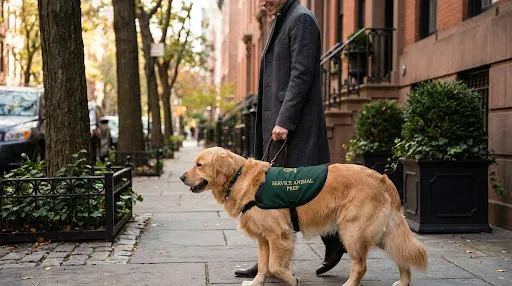
Navigating New York City presents extraordinary challenges for individuals with physical mobility impairments, spinal cord injuries (SCI), and neurological conditions. Between tight subway turnstiles, crowded midtown crosswalks, uneven flagstone sidewalks, and narrow elevator vestibules, the urban landscape requires an exceptionally high caliber of assistance.
A properly conditioned mobility service dog transforms this environment from a labyrinth of physical barriers into an accessible world. However, training a canine partner to execute physical balance support and wheelchair alignment while maintaining absolute public access neutrality is one of the most rigorous disciplines in working canine ethology.
Here is an inside look at the specialized biomechanics, gear protocols, and public access training required to prepare mobility assistance dogs for life in New York City.
1. The Biomechanics of Balance Bracing and Counterbalance
Unlike guide dogs or psychiatric service dogs, physical mobility assistance dogs must absorb physical load without compromising their own musculoskeletal longevity.
- Structural Suitability & Orthopedic Screening: A dog designated for counterbalance or bracing work must possess substantial bone density, square shoulder angulation, and clear orthopedic clearances (OFA Good/Excellent hips, normal elbows, and clean spine radiographs). Generally, the canine must weigh at least 45% of the handler’s body weight for counterbalance tasks, and strict upward-pressure bracing is reserved for larger breeds such as German Shepherds, Labradors, and Giant Schnauzers.
- The Counterbalance Harness: Traditional walking harnesses apply pressure horizontally. In contrast, specialized mobility harnesses utilize a rigid upright handle mounted to a wide, padded breastplate. When the handler experiences sudden ataxia or loss of balance, the dog braces their core and leans into the handler’s gait, stabilizing the kinetic chain.
- Brace On Command: The dog is conditioned to execute a rock-solid, four-square stance on a verbal cue (such as “Brace” or “Hold”). In this posture, the dog locks their shoulder girdle and hindquarters, allowing the handler to transfer partial body weight to push up from a chair, sofa, or subway bench.
2. Wheelchair & Assistive Device Integration
One of the most complex tasks for a mobility dog is mastering spatial awareness around motorized power chairs, manual wheelchairs, canes, and walkers.
- Perimeter Position Conditioning: A service dog must never drift into the turning radius of a power wheelchair’s drive wheels or cross in front of footplates. We condition an unwavering “Heel Alongside” cue where the dog’s shoulder remains aligned exactly with the wheelchair armrest, matching acceleration, zero-degree pivots, and sudden emergency stops.
- Automatic Item Retrieval: Dropping a set of keys, an iPhone, or a MetroCard from a seated wheelchair position often leaves a handler stranded. Mobility dogs are trained on discrimination-based retrieving: retrieving metal, smooth glass, and plastic objects and delivering them gently into the handler’s lap without biting or damaging the items.
- Door Push-Plate & Elevator Operation: In luxury residential high-rises and transit stations, dogs learn to target automated handicap push-plates using their nose or paw, holding the door open while the handler passes through.
3. Conquering NYC Subway Gaps and Transit Crowds
The MTA subway system is the ultimate proving ground for a service animal team. Platform train gaps, screeching metal rails, moving escalators, and dense rush-hour crowds demand absolute unflappable composure.
- Subway Platform Gap Awareness: Dogs are trained to halt automatically at the yellow tactile warning strip on subway platforms. Upon boarding, they execute a precise leap over the platform gap, guiding the handler safely across before assuming a compact “tuck” beneath the train seat.
- Elevator Vestibule Neutrality: In crowded residential lobbies, mobility dogs must tuck tightly behind their handler’s assistive device, ignoring outstretched hands, barking neighborhood dogs, and sudden swinging doors.
- Pavement & Grate Avoidance: Service dogs are conditioned to steer their handlers around subway ventilation grates, oily metal construction plates, and steep curb drops.
4. ADA Title III Public Access and Handler Rights
Under Title III of the Americans with Disabilities Act (ADA), service animals are defined specifically as dogs (or miniature horses) individually trained to perform work or tasks directly related to the handler’s disability.
In New York City, public accommodations (including fine dining establishments, Broadway theaters, museums, and private rideshares) may legally ask only two questions:
- Is the dog a service animal required because of a disability?
- What work or task has the dog been trained to perform?
Public access testing requires the dog to remain completely handler-focused, never seeking attention from strangers, never sniffing restaurant tables, and maintaining silent composure in high-distraction settings.
At Gotham Paw, our physical mobility service conditioning program bridges the gap between clinical task training and high-altitude wilderness conditioning. Because service dogs carry immense responsibility in the city, our Catskill Mountain expeditions provide them with the off-duty sensory decompression and cardiovascular rejuvenation they need to thrive over a decade of service.