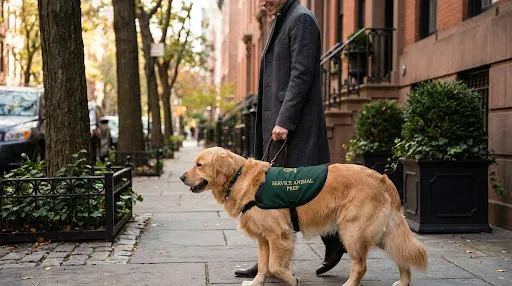
Service dog training for mobility and psychiatric disabilities
I train dogs to do specific tasks for people with disabilities, then practice those tasks where you actually live: on sidewalks, in elevators, on the subway and in restaurants.
Who this program is for
This program is designed for people who use a wheelchair, walker, cane, or crutches, or who live with a psychiatric disability such as PTSD, severe panic disorder, or agoraphobia. You can bring your current dog for evaluation, or I can help you evaluate and select a suitable puppy or adult candidate.
Tasks I train
Mobility tasks include retrieving dropped items, opening heavy doors using a pull strap, pressing accessible handicap door buttons, switching lights, and working closely alongside a wheelchair or walker. Psychiatric tasks include deep pressure therapy (DPT), creating physical space buffers in dense crowds, interrupting repetitive anxious behaviors, and leading you to an exit during panic episodes. (Please note: I do not train guide dogs for blind handlers or medical alert tasks).
Physical Mobility, Assistive Devices & Task Engineering
Our clinical training architecture is individually tailored to your medical, physical, or psychiatric needs under ADA Title II and III guidelines.
Physical Mobility & SCI Assistance
Specialized tasks for handlers with spinal cord injuries (paraplegia, quadriplegia), stroke recovery, and motor impairments.
- ✓ Ground Item Retrieval: Keys, phones, wallets, credit cards & dropped medication to hand/lap
- ✓ Environmental Mechanics: Tug-strap door opening, cabinet pulling & light switch toggling
- ✓ Accessibility Buttons: Hitting automatic handicap door & elevator push pads
- ✓ Transfer Support: Steady bracing during wheelchair-to-bed and sit-to-stand transfers
Canes, Walkers & Wheelchairs
Complete desensitization and synchronization alongside personal mobility and assistive equipment.
- ✓ Wheelchair Synchronization: Strict heel alongside manual & motorized wheels without entanglement
- ✓ Walker & Rollator Safety: Spatial clearance around frames eliminating tripping or collision hazards
- ✓ Fallen Device Recovery: Retrieving dropped walking canes, crutches, or reachers directly to hand
- ✓ Counterbalance Support: Upward harness stabilization for handlers experiencing gait ataxia
Vision & Guide Foundations
Foundational guide work and spatial awareness for handlers navigating low vision, partial sight, or sensory impairment.
- ✓ Curb & Edge Alerts: Automatic sitting/stopping at curbs, subway platform edges, and drop-offs
- ✓ Obstacle Avoidance: Guiding safely around low scaffolding, sidewalk dining barriers, and street grates
- ✓ Elevation Changes: Indicating stairs, ramps, escalators, and uneven street transitions
- ✓ Directional Guiding: Finding doors, crosswalk buttons, and empty seating in transit
PSD & Medical Alert Tasks
Clinical task imprinting for PTSD, severe anxiety, agoraphobia, POTS/cardiac spikes, and medical emergencies.
- ✓ Deep Pressure Therapy (DPT): Calibrated torso/lap pressure calming autonomic nervous system arousal
- ✓ Crowd Buffering ("Block" & "Cover"): Maintaining physical boundaries in elevators, lines, and crowds
- ✓ Tactile Grounding: Nose nudge and paw interruption of panic attacks, dissociation, and flashbacks
- ✓ Medical Alert & Response: Heart rate spike detection, syncope response, and emergency phone retrieval
What the Experience Looks Like
From the moment our van pulls up to your NYC building to our post-service report, every phase is orchestrated with military precision and gentle, compassionate care.
Candidate Screening & Device Acclimation
Screening temperament, environmental stability, and sound sensitivity; desensitization to wheelchairs, walkers, or crutches.
In-Home Task Conditioning
Teaching specific disability tasks (item retrieval, button pressing, pull straps, or deep pressure therapy) in a controlled home environment.
Real-World NYC Public Access Practice
Practicing task reliability and environmental neutrality in Grand Central Terminal, crowded subway platforms, kneeling city buses, and busy restaurants.
Public Access Evaluation & Handler Coaching
Comprehensive public access evaluation, handler coaching, co-op board documentation, and long-term maintenance protocols.
A Note on Service Dog Certification
There is no official ADA certification, test, or government registry for service dogs, and commercial online certificates carry zero legal validity. Under the Americans with Disabilities Act (ADA), public businesses may ask only two questions: (1) Is the dog a service animal required because of a disability? and (2) What work or task has the dog been trained to perform? What you receive from Gotham Paw is a thoroughly trained dog, a detailed written task curriculum, an itemized training log, and the results of a rigorous public access evaluation based on Assistance Dogs International standards.
White-Glove Standards with Zero Hidden Fees
We believe high-net-worth service should be all-inclusive. Here is what is built into every reservation.
Rigorous Public Access Conditioning
Field practice on the NYC subway, kneeling MTA buses, crowded Midtown crosswalks, elevators, and outdoor cafes.
Veterinary Orthopedic Clearance
Prior to any physical or counterbalance tasking, the dog undergoes OFA hip and elbow screening and veterinary spinal clearance.
Written Task Logs & Documentation
Complete documentation of task mastery, hours logged, and public access evaluation standards for residential co-ops and airlines.
Experienced Nonprofit Leadership
Personally coached by Christopher Mejo, who has over 8 years of clinical experience placing service animals across New York.
Safety Is Not a Buzzword. It Is Our Foundation.
From satellite telemetry in Catskill valleys to crash-tested transport pods, our safety infrastructure exceeds ordinary pet care by an order of magnitude.
Strict 1:4 Handler Ratio
Four dogs maximum per session, personally supervised by Christopher Mejo.
First Aid & CPR Preparedness
Active Canine Wilderness First Aid and Pet CPR credentials with comprehensive trauma kits.
Veterinary Emergency Access
Kingston Animal Hospital (24/7) emergency coverage 12–15 minutes from Catskills trailheads.
Zero-Risk Weather Protocol
Rescheduled for lightning, heat index >85°F, or wind chill <15°F with 100% account credit.
Program Options & Membership Tiers
Choose between single reservations or recurring monthly memberships for guaranteed scheduling and priority status.
Candidate Assessment (2 Hours)
In-depth assessment of your dog's temperament, biddability, sound neutrality, and physical structure. Credited toward the program if accepted.
- ✓ 2-hour hands-on evaluation with Christopher Mejo
- ✓ Assessment of startle recovery, device neutrality & drive
- ✓ Detailed written feasibility report and task recommendations
- ✓ Full $350 credited toward program fee upon enrollment
Full 6-Month Program
Complete end-to-end service dog development: in-home task conditioning, device integration, 10 weeks of public access field practice, and final evaluation.
- ✓ Comprehensive 6-month progressive task training
- ✓ 10 weeks of real-world NYC public access sessions
- ✓ MTA subway, bus, restaurant & elevator conditioning
- ✓ Detailed task list & ADI-aligned evaluation records
- ✓ Direct handler coaching and lifetime maintenance support
Task Training Module
For dogs that already have reliable basic obedience and public manners: 8 focused private sessions to teach specific disability tasks.
- ✓ Eight 75-minute private task conditioning lessons
- ✓ Focus on specific mobility or psychiatric tasks
- ✓ In-home and immediate neighborhood implementation
- ✓ Written task documentation and maintenance video guide
Frequently Asked Questions
Everything you need to know about our Service Dog Training protocols, scheduling, and safety guarantees.
Q. What is the difference between a service dog and an emotional support animal (ESA)?
A service dog is trained to perform specific tasks directly related to an individual's disability, and Title III of the ADA grants them the right to accompany their handler into public places. An emotional support animal provides comfort by its presence but is not trained to perform specific disability tasks, so the ADA public access provisions do not apply to them.
Q. Can my current family dog become my service dog?
Possibly. Successful service dogs need exceptional environmental neutrality, rapid recovery from sudden noises, zero dog-directed or human-directed reactivity, and solid physical health. Our 2-hour assessment evaluates these qualities honestly.
Q. What happens if my dog does not pass the assessment?
If a dog shows signs of chronic environmental anxiety or stress that would make public service work unfair to their welfare, I will provide an honest assessment and recommend other options, such as addressing anxiety at home or helping you evaluate a different candidate.
Q. Can you train both mobility and psychiatric tasks for the same handler?
Yes, provided the dog has the structural frame for mobility work and the calm, observant temperament required for psychiatric grounding tasks.
Providing Service Dog Training Across Premier NYC Neighborhoods
Give Your Companion the Biological Fulfillment They Deserve
Speak directly with founder Christopher Mejo to schedule your complimentary 30-minute in-person consultation (or submit your passed AKC CGC certificate).